

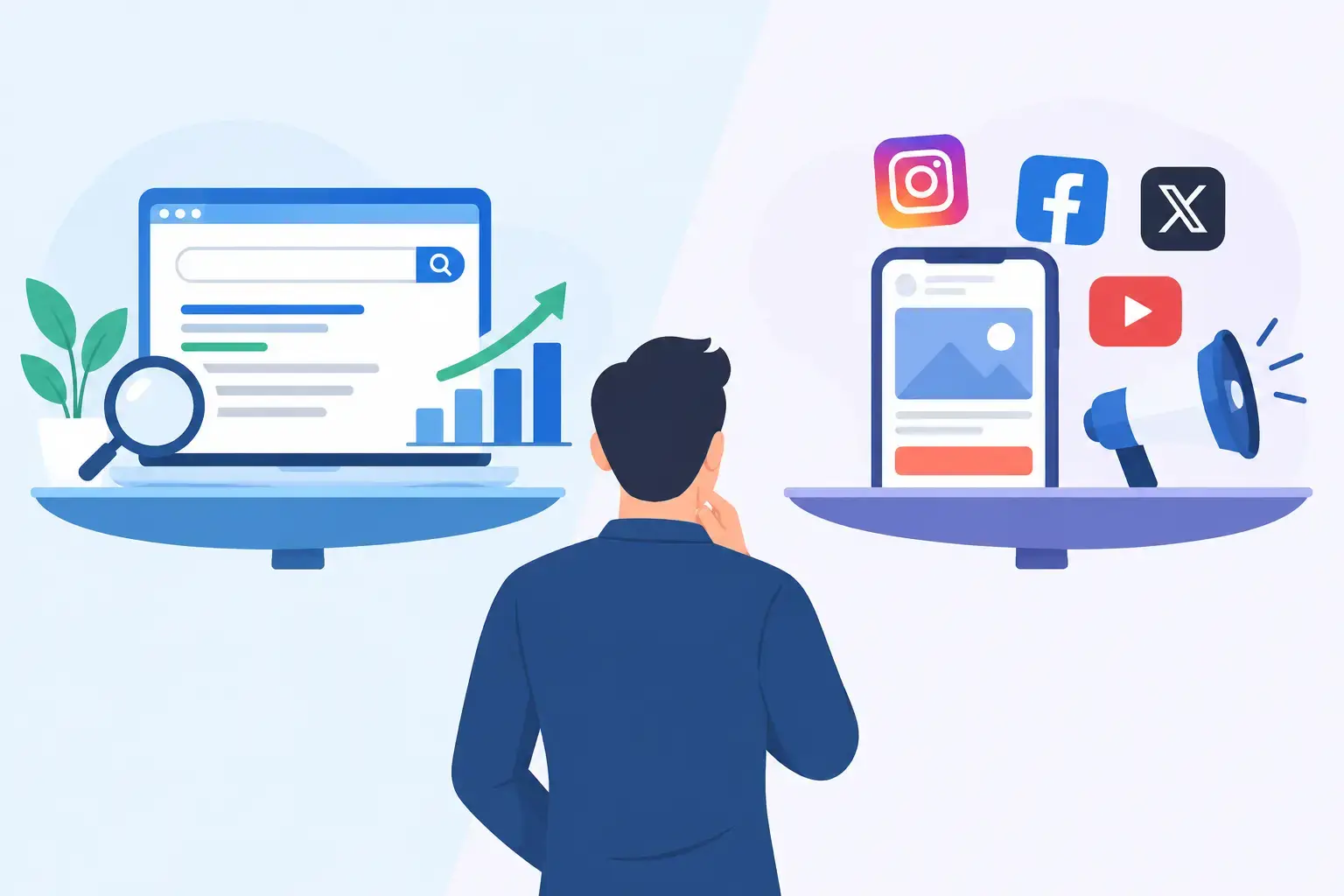
A Dubai restaurant with empty weekday tables does not need more vague “awareness.” It needs hungry people nearby to find its menu, book a table, or call before they choose another venue. A B2B engineering firm in Lebanon has a different challenge: it needs to appear when a decision-maker searches for a specialized solution months before a contract is signed. That is the real question behind SEO versus social advertising: which channel matches the way your customers make decisions?
The wrong answer is often “whichever is cheaper” or “whichever produced the most clicks last week.” Search engine optimization and paid social campaigns create value in different ways, on different timelines, and for different stages of the buyer journey. A smart marketing budget uses that difference instead of forcing one channel to do every job.


SEO Versus Social Advertising: The Core Difference
SEO helps your business earn visibility when people actively search for answers, products, services, or local providers. A well-optimized website can appear for searches such as “accounting services near me,” “hotel booking in Dubai,” “custom e-commerce website,” or “CCTV installation company.” The user already has a need. Your job is to be visible, credible, and easy to contact when that need appears.
Social advertising places your message in front of selected audiences while they browse platforms such as Facebook, Instagram, LinkedIn, TikTok, or YouTube. They may not be looking for your service at that moment. Your campaign creates interest through a strong offer, a useful message, a product demonstration, or a visual that stops the scroll.
Put simply, SEO captures existing demand. Social advertising can create demand, accelerate it, and bring your brand back in front of people who have already shown interest.
Neither channel is automatically better. The strongest choice depends on your sales cycle, competition, customer behavior, budget, and the quality of the website behind the campaign.
When SEO Is the Better Business Investment
SEO is usually the stronger long-term investment when customers use search engines to solve a clear problem. Professional services, healthcare providers, travel businesses, home services, IT companies, automotive businesses, and B2B suppliers often fit this model. People search because they need something now or are actively comparing options.
Unlike an ad campaign, SEO visibility does not disappear the moment you pause spending. A high-quality service page, local business profile, useful article, or product category page can keep attracting qualified visitors over time. This creates a compounding effect: every improvement to website structure, page speed, content quality, local relevance, and conversion paths can strengthen the value of your digital presence.
That does not mean SEO is free or instant. It requires strategy, technical work, content, and patience. Competitive terms can take months to move, especially in crowded markets. Search engines also need evidence that your business is relevant and trustworthy. A thin website with copied text, slow loading pages, or no clear service information will struggle, even if the business itself is excellent.
SEO is particularly valuable when a lead has high lifetime value. If one corporate client, property deal, software project, or hospitality partnership can generate significant revenue, investing in pages that attract high-intent searches makes commercial sense. You are building an asset that keeps working beyond a single promotion.
SEO works best when your website can convert
Ranking is not the final goal. A visitor who cannot quickly understand your offer, see proof of your work, or request a quote is a missed opportunity. Good SEO must be connected to responsive web design, fast hosting, clear calls to action, location information, service pages, and reliable lead tracking.
For a local company, that may mean a dedicated page for each priority service area. For an e-commerce brand, it may mean optimized category pages, product information, reviews, and a checkout experience that works flawlessly on mobile. For a B2B company, it may mean case studies, industry-specific landing pages, and a simple route to speak with a specialist.
When Social Advertising Delivers Faster Results
Social advertising is built for speed, audience targeting, and message testing. It can put a new offer in front of thousands of relevant people within days. That makes it useful for product launches, seasonal promotions, events, new restaurant openings, limited-time travel packages, real estate announcements, and e-commerce sales.
It is also a strong option when people are unlikely to search for exactly what you sell. A customer may not type “handmade gift box for corporate clients” into a search engine, but they may respond to an attractive Instagram video at the right time. A startup with a new app may need to explain the problem it solves before users know to look for it.
The advantage is control. You can target by location, age range, interests, behavior, job role, or prior engagement, depending on the platform and campaign objective. You can also test multiple creative angles quickly. One message may focus on affordability, another on speed, another on premium quality. The data will show which one produces qualified leads rather than just likes.
The trade-off is that results are temporary. Once the campaign stops, traffic usually stops with it. Social ad costs can also rise as more advertisers compete for the same audience. A campaign with beautiful visuals but a weak offer, unclear targeting, or a poor landing page can spend money quickly without creating sales.
Social ads need a clear next step
Do not send paid traffic to a generic homepage and hope visitors figure it out. A social campaign should lead to a focused destination that matches the ad: a booking form, product collection, WhatsApp conversation, consultation request, downloadable guide, or time-sensitive offer.
Fast follow-up matters just as much. If a prospect submits a lead form and waits two days for an answer, the campaign has done its job but the sales process has failed. Businesses that respond quickly, qualify leads properly, and track outcomes by source have a major advantage over competitors who only count impressions.
How to Choose Between SEO and Social Advertising
Start with customer intent. If people already search for your category, location, or service, SEO should be part of your core growth plan. If you are introducing a new product, promoting an impulse-friendly offer, or need rapid visibility, social advertising can create momentum faster.
Then consider timing. A business that needs leads this month should not rely on SEO alone. Paid social can create immediate activity while search visibility is being developed. On the other hand, a business that depends entirely on paid campaigns may face unstable costs and no long-term traffic foundation. This is why the best strategy is often a phased combination rather than an either-or decision.
Budget matters, but not in the simplistic sense of choosing the lowest monthly fee. Ask what a qualified lead is worth, how long customers stay, and how many leads your team can handle. A small business with limited capacity may be better served by targeting a narrow set of high-value SEO terms than by generating hundreds of low-intent social leads. A retail brand with a strong online store may benefit from social campaigns that scale quickly during peak seasons.
Your creative resources also matter. Social advertising rewards fresh visuals, short videos, customer stories, and frequent testing. SEO rewards useful content, clear information architecture, technical performance, and ongoing optimization. If you cannot sustain one approach internally, work with a partner that can connect campaign delivery with web development, content, analytics, and conversion improvement.
A Practical Combined Strategy
The most effective approach is often to let each channel do the job it does best. Use SEO to build high-intent pages around the services, products, and locations customers search for. Use social advertising to introduce your brand, promote timely offers, build remarketing audiences, and bring previous website visitors back when they are ready to act.
For example, a travel agency can use SEO to attract people searching for family holiday packages, visa support, or flights from a specific city. Social ads can showcase destination videos, early-booking deals, and testimonials to inspire travelers before they begin searching. Visitors who view a package page but do not inquire can later see a focused ad that encourages them to complete the booking conversation.
This combination also improves learning. Search queries reveal the language customers use when they have intent. Social campaigns reveal which visuals, offers, and audience segments attract attention. Both sources of data can improve your website copy, sales scripts, email campaigns, and future marketing decisions.
Measure Revenue, Not Just Traffic
SEO and social advertising can both look successful when measured with vanity metrics. A rise in followers, impressions, clicks, or page views may be useful, but none of them pays salaries on its own. Track the actions that matter to your business: calls, form submissions, WhatsApp messages, booked meetings, online purchases, qualified leads, and closed sales.
Review cost per lead, but go further. Which source generates leads that answer the phone, attend consultations, make repeat purchases, or sign larger contracts? A campaign with a higher initial cost may be more profitable if it brings better customers. Likewise, an SEO page with modest traffic may be extremely valuable if it consistently attracts serious buyers.
Your(1)Site approaches digital growth as connected work, not isolated tasks. The website, hosting, tracking, creative, SEO, social campaigns, and follow-up path should all support one commercial goal: turning attention into customers.
Choose the channel that matches your immediate need, but build the foundation your business will still benefit from next year. When every click lands on a fast, credible, conversion-focused digital presence, both search visibility and social advertising have a far better chance of producing results you can measure.