


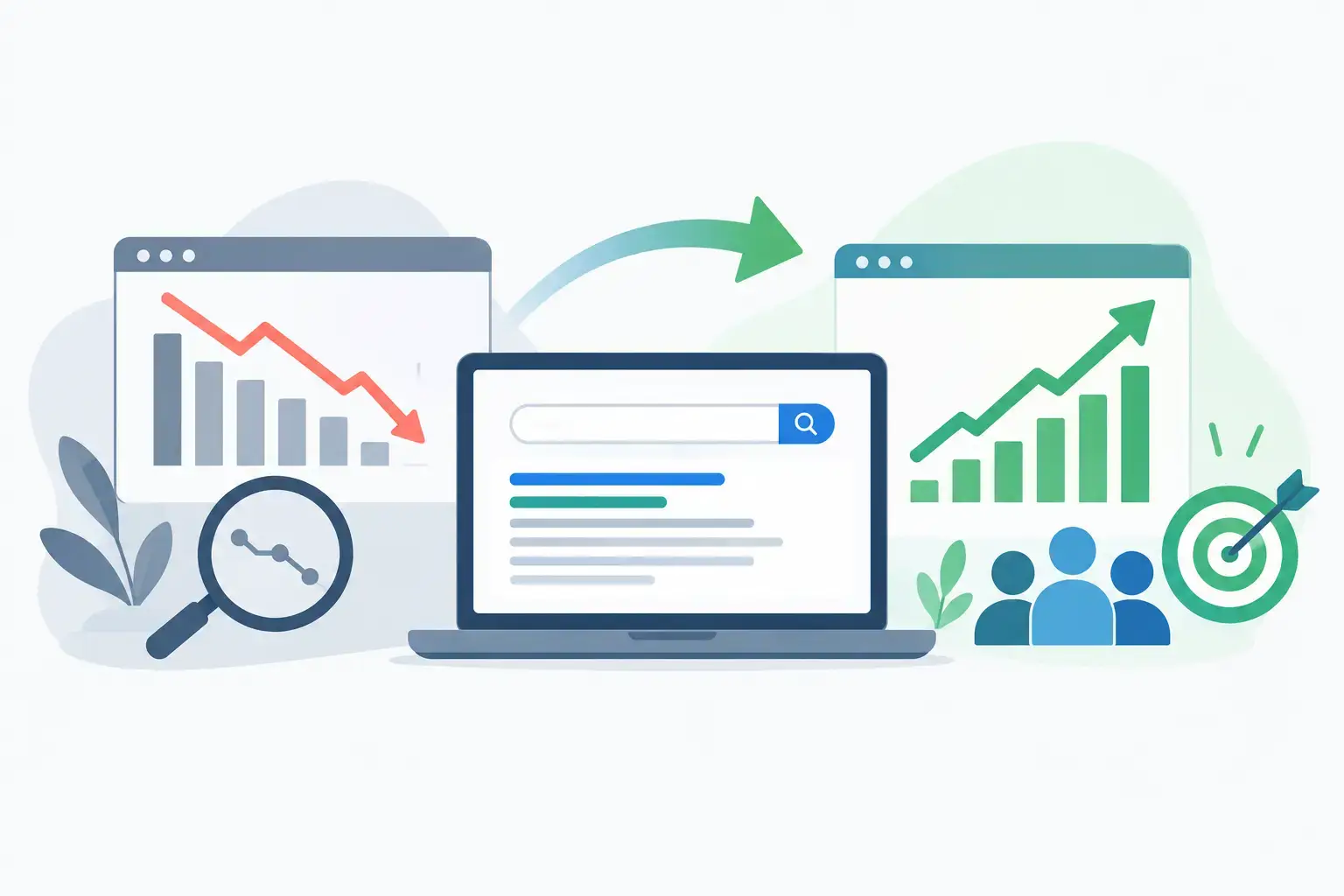
A business owner notices the problem before the analytics report makes it obvious. Fewer inquiry forms arrive. Calls slow down. A once-reliable service page no longer appears when customers search for it. This SEO recovery example shows how a site can move from declining visibility to qualified leads by fixing the actual causes, not by chasing quick ranking tricks.
For small and mid-sized businesses, a traffic loss is not just a marketing metric. It can affect appointments, sales, staff workload, and expansion plans. The right recovery process connects technical SEO, useful content, site performance, and conversion tracking so the website can do its job again: bring the right people to the business and help turn them into customers.


The SEO recovery example: What went wrong
Imagine a Dubai-based home services company that had built solid organic traffic over several years. Its website ranked for high-intent searches related to repair, installation, and maintenance. Then, over four months, organic sessions dropped by 42 percent. Lead form submissions fell by 31 percent.
The first reaction was to assume a search engine update had targeted the website. That can happen, but it is often only part of the story. A proper audit found several overlapping problems: a recent redesign had changed important URLs without complete redirects, mobile pages loaded slowly, service pages had become thinner, and multiple pages were competing for the same local search terms.
None of these issues alone had to cause a major loss. Together, they made it harder for search engines to understand the site and less attractive for visitors who did find it. This is common after a redesign, CMS migration, hosting change, or rushed content update. Recovery starts by identifying the full picture rather than fixing the first issue that appears in a dashboard.
Start with evidence, not assumptions
An SEO recovery should begin with a timeline. Compare traffic, leads, rankings, crawl errors, page indexing, and site changes across the same period. If the decline began immediately after a redesign, migration, or server issue, technical work should be examined first. If rankings gradually weakened while competitors published stronger pages, content quality and topical coverage may be the bigger concern.
For this business, the audit reviewed search performance page by page. The team did not focus only on total traffic because a lower traffic number can be misleading. A blog post might lose visitors without affecting revenue, while a drop in one emergency repair page could reduce calls every day.
The investigation also separated branded and non-branded searches. Branded traffic comes from people already looking for the company by name. Non-branded traffic comes from potential customers searching for services. A decline in non-branded visibility often points to an SEO or competitive problem that needs action.
At this stage, a capable team checks the foundation: indexability, redirects, canonical tags, broken internal links, mobile usability, server response, duplicate pages, XML sitemaps, structured data, and page speed. For local businesses, business details must also be consistent across the site, including service areas, phone numbers, and location information.
Fix the technical barriers first
The site redesign had created 38 broken URLs that previously attracted valuable organic visits. Some old URLs returned error pages. Others redirected to the homepage instead of the closest matching service page. This creates a poor experience for users and can weaken the relevance signals search engines receive.
The recovery plan mapped every important old URL to its most relevant new destination. Pages without a true replacement were given a useful alternative only when it made sense. The team repaired internal links, updated the sitemap, and requested fresh crawling after the changes were live.
Mobile speed was the next issue. Large uncompressed images, unnecessary scripts, and weak hosting resources had pushed the main service pages beyond acceptable loading times. The solution was not to remove every visual element. The business still needed strong project photos and clear calls to action. Instead, images were optimized, scripts were reviewed, caching was configured, and hosting performance was improved.
This is where trade-offs matter. A visually impressive website that loads slowly can lose both rankings and leads. A stripped-down site may load quickly but fail to build trust. The best solution balances design, speed, security, and the information customers need before they contact the business.
Rebuild service pages around customer intent
Technical corrections helped search engines revisit the website, but they did not solve the content problem on their own. Several service pages used nearly identical text with only the service name changed. They did not explain what the company handled, who the service was for, what customers could expect, or why the business was a credible choice.
The revised pages were written for real decision-making. Each one covered the service scope, common customer problems, areas served, response expectations, proof of experience, and a direct route to request a quote or call. Instead of forcing the same keyword into every paragraph, the content used natural language that matched how customers searched and asked questions.
For example, a generic page titled “AC Services” became a focused page that addressed installation, maintenance, repair symptoms, emergency support, and commercial requirements. It included relevant FAQs, original images, and clear contact options. The page became more useful without becoming unnecessarily long.
Location pages received the same attention. A business should not publish dozens of near-identical city pages just to target more areas. Search engines and customers can recognize thin location content quickly. Build location pages only where the company genuinely serves customers and can provide specific, useful details.
Protect the pages that generate revenue
Not every page deserves equal recovery effort. The home services company prioritized pages based on commercial value: emergency services, high-margin installations, and recurring maintenance plans. These were the pages most likely to produce calls and quote requests.
A simple priority model helped the team decide what to address first. They looked at existing rankings, monthly search demand, conversion history, service profitability, and how much work each page needed. A page ranking near the bottom of page one or the top of page two can often offer a faster opportunity than a page with no visibility at all.
The calls to action were improved as well. A page can rank well and still underperform if visitors cannot easily take the next step. On mobile, the business added prominent call buttons, shorter forms, service-specific contact prompts, and trust signals near the conversion points. SEO and conversion rate optimization should work together because traffic without action does not create growth.
Measure recovery in leads, not only rankings
Within the first month after technical fixes, crawling errors declined and important pages began returning to search results. Over the following three months, non-branded organic traffic increased by 28 percent compared with the low point. More importantly, qualified organic leads increased by 36 percent.
The numbers will differ for every business. Some websites recover quickly after a redirect or indexing issue is fixed. Others need several months of content improvements, authority building, and technical cleanup before results stabilize. Competitive industries, new domains, and major quality problems usually require more patience.
The lesson from this SEO recovery example is that recovery is not one task. It is a disciplined sequence: identify the loss, repair technical barriers, improve pages that deserve to rank, and measure the actions that support revenue. Ranking reports are useful, but calls, bookings, quote requests, and sales provide the stronger business signal.
When a recovery plan needs deeper work
Sometimes an audit reveals more than a few broken pages. A website may have years of duplicate content, an unreliable hosting environment, weak site architecture, poor mobile usability, or no clear tracking of leads. In those situations, patching individual pages can waste time. A coordinated rebuild may deliver better value.
This is especially true for businesses that rely on their website as a central sales channel. Website design, development, hosting, analytics, content, and SEO should not operate as separate pieces. When they are planned together, each improvement supports the next one: faster pages help users, clearer content improves relevance, tracking shows what converts, and ongoing optimization protects performance.
Your(1)Site helps businesses turn this kind of diagnosis into an action plan, combining technical website expertise with performance-focused digital marketing. The goal is not to make reports look better. It is to create a dependable online presence that attracts customers and gives business owners clear visibility into results.
If your organic traffic has dropped, save the guesswork for later. Start by checking what changed, which pages lost visibility, and whether those pages still offer the fastest and clearest route for a customer to take action. That evidence will point to the recovery work that matters most.