

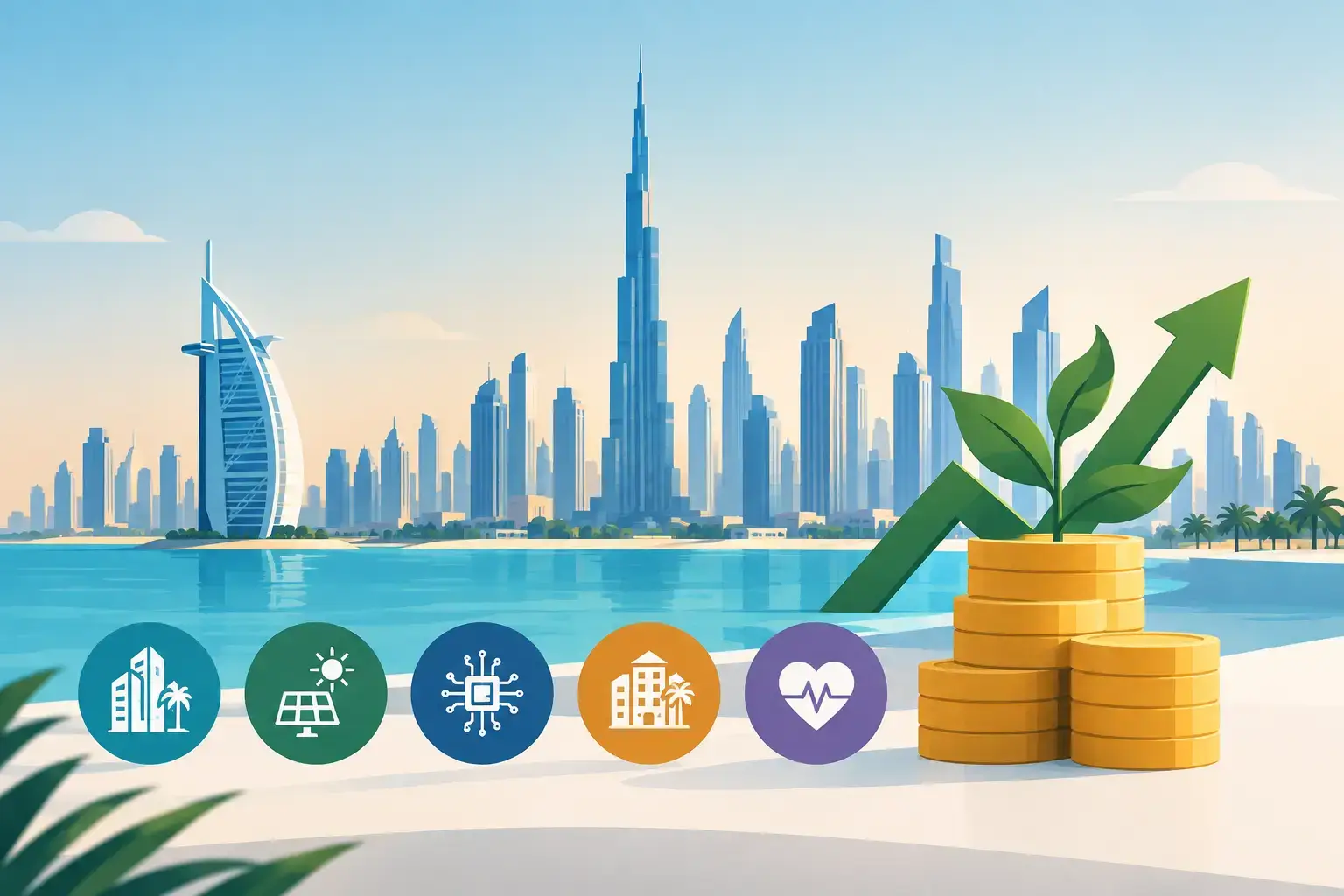
A Dubai investment decision is rarely only about entering one market. For many companies, it is about positioning a business at the intersection of the Middle East, Africa, South Asia, and global trade routes while building an operating base designed for growth. Dubai investment sectors reflect that wider role: they combine established commercial strengths with policy support, advanced infrastructure, and ecosystems built to attract international capital and capability.
The right sector is the one that aligns your commercial model with Dubai’s market access, licensing requirements, operating location, and long-term expansion plans. A technology founder selling across borders will have different priorities from a manufacturer building a regional supply chain or a family office establishing an investment platform. Evaluating the opportunity starts with that distinction.


Dubai Investment Sectors With Global Reach
Dubai’s economy is diversified by design. Its sector ecosystems are connected by a business environment that supports international ownership in many activities, competitive tax conditions, modern digital government services, and access to specialized free zones and mainland business structures. The city’s logistics, financial, real estate, and technology capabilities often reinforce one another rather than operating as separate markets.
Technology, ICT, and the Digital Economy
Technology is a natural entry point for startups, scale-ups, and multinational innovation teams. Dubai offers a growing base for software, fintech, artificial intelligence, cloud services, cybersecurity, e-commerce platforms, and digital media. Businesses can use Dubai as a regional headquarters, product-development center, sales hub, or launch market, depending on their model.
For founders, the opportunity is supported by a diverse talent base, access to accelerators and investors, and a customer market that is highly connected and digitally engaged. For larger companies, the value often lies in proximity to enterprise buyers and public-sector innovation programs, alongside the ability to coordinate operations across multiple time zones.
The practical question is whether your activity requires a mainland license, a free-zone entity, or a combination of structures. Companies selling directly into the UAE market, contracting locally, or maintaining operational teams should assess their setup requirements early. A digital-first business may have more flexibility, but licensing still needs to reflect the activities it will actually perform.
Finance, Wealth, and Investment Management
Dubai has become a significant center for financial services, private wealth, family offices, asset management, insurance, and financial technology. Its position between major capital markets makes it relevant to investors seeking exposure to regional growth, as well as firms serving internationally mobile clients.
This sector is particularly attractive to private-equity firms, venture-capital funds, wealth managers, and family offices that need a jurisdiction combining connectivity, a sophisticated professional-services market, and a favorable environment for regional investment activity. The availability of specialized financial ecosystems can also help firms locate near counterparties, advisers, and institutional networks.
Regulated financial activities require careful planning. Licensing, governance, compliance, and office-location requirements can differ significantly based on the service provided and the clients served. A firm should define its regulated perimeter before choosing an entity type, rather than treating company formation as a purely administrative step.
Trade, Logistics, and E-Commerce
Dubai’s trade and logistics sector is built on integrated air, sea, road, and warehousing infrastructure. For distributors, trading companies, freight providers, and e-commerce operators, this creates a practical advantage: goods can move efficiently between suppliers, regional customers, and international markets.
The sector suits businesses handling consumer goods, industrial inputs, spare parts, food products, luxury items, and high-value shipments. E-commerce businesses can also benefit from a dense logistics ecosystem, digital-payment adoption, and a population accustomed to fast delivery and cross-border purchasing.
Location is central to the investment case. A business focused on import, storage, re-export, and fulfillment may prioritize proximity to ports, airports, or logistics clusters. A company that needs to serve local customers through a physical retail or distribution network may have different mainland operating needs. Customs treatment, product registration, warehouse specifications, and last-mile delivery arrangements should all be considered before launch.
Manufacturing and Advanced Industry
Manufacturing in Dubai extends beyond basic production. Opportunities include food processing, pharmaceuticals, medical devices, machinery, electronics, aerospace-related activities, packaging, chemicals, and advanced materials. Companies are drawn by industrial infrastructure, supply-chain connectivity, access to regional demand, and the ability to integrate production with trade and distribution operations.
For international manufacturers, Dubai can support several models: local production for the UAE market, regional export manufacturing, assembly and customization, or a commercial hub that manages procurement and aftermarket services. The strongest option depends on freight economics, input availability, market demand, and the level of localization required.
Industrial investors should examine site utilities, environmental approvals, staffing requirements, product standards, and import-export processes at the same time as licensing. A facility decision is more durable than a service-office setup, so the analysis should include room for capacity expansion and supply-chain resilience.
Energy, Cleantech, and Sustainability Solutions
Dubai’s focus on energy transition and resource efficiency is creating opportunities for companies in renewable energy, energy storage, smart grids, water technology, waste management, green buildings, and low-carbon mobility. These businesses can serve a market where large-scale infrastructure, real estate development, and urban services create demand for practical, scalable solutions.
The commercial opportunity is not limited to project developers. Technology providers, engineering firms, specialist consultancies, equipment suppliers, and climate-focused investors all have a role to play. A company with proven solutions elsewhere can use Dubai as a base to pursue partnerships and projects across the region.
Timelines in this sector may be longer than in software or trading because projects can involve procurement cycles, technical qualification, and multiple stakeholders. Investors should balance the size of the opportunity against the time needed to establish reference projects and local relationships.
Healthcare, Pharmaceuticals, and Life Sciences
Healthcare investment in Dubai is supported by a growing population, medical tourism demand, and continued investment in clinical capacity and health innovation. The sector includes hospitals, specialty clinics, diagnostics, digital health, pharmaceuticals, medical devices, laboratory services, and health education.
Companies entering this market should treat regulation as part of their market strategy. Product registration, professional licensing, clinical standards, facility approvals, and data requirements can shape the route to market. The same applies to pharmaceutical and device businesses, where importation, storage, labeling, and distribution processes require sector-specific preparation.
For firms with differentiated capabilities, Dubai offers an opportunity to combine market entry with regional expansion. A healthcare operator may begin with a focused specialty offering, while a life-sciences company may establish commercial, regulatory, and distribution functions before scaling further.
Real Estate, Construction, and the Creative Economy
Real estate and construction remain important to Dubai’s commercial landscape, supported by ongoing development across residential, hospitality, industrial, retail, and mixed-use assets. Opportunity extends beyond developers and contractors to architecture firms, engineering companies, building-technology providers, property-management businesses, and materials suppliers.
The creative economy adds another dimension. Design, media, gaming, film, advertising, fashion, and content production can benefit from Dubai’s international population, event calendar, consumer market, and growing digital economy. These sectors are especially relevant for companies whose growth depends on regional brand building and access to diverse creative talent.
Choosing the Right Sector Entry Model
The most effective way to assess Dubai investment sectors is to work backward from your operating model. Start with the revenue source: will you sell within the UAE, serve regional clients, hold intellectual property, manufacture goods, manage investments, or provide regulated professional services? Then identify the activities that must appear on the license and the location best suited to those activities.
Mainland and free-zone structures can both support international businesses, but they are designed for different operational needs. The right choice depends on your commercial footprint, ownership requirements, client contracts, staffing plans, and sector regulations. Some companies also evolve their structure as they grow, adding a local operating presence after establishing a regional base.
Talent planning deserves the same attention as entity formation. Consider which roles need to be based in Dubai, how visas and employment administration will be managed, and whether specialist skills are available locally or must be recruited internationally. Banking, office or industrial space, and compliance obligations should be built into the launch timeline rather than handled after incorporation.
Invest in Dubai can help investors connect official setup guidance with sector information, so commercial decisions and government requirements are considered together. That approach is especially useful when a business spans several activities, such as a technology company with a logistics operation or a healthcare investor with regulated distribution requirements.
A strong Dubai entry plan is specific: identify the customer, select the sector ecosystem, confirm the regulatory path, and establish the structure that supports the next stage of growth. With those decisions made early, Dubai can become more than a market entry point. It can become the operating base from which your business builds its next international chapter.