


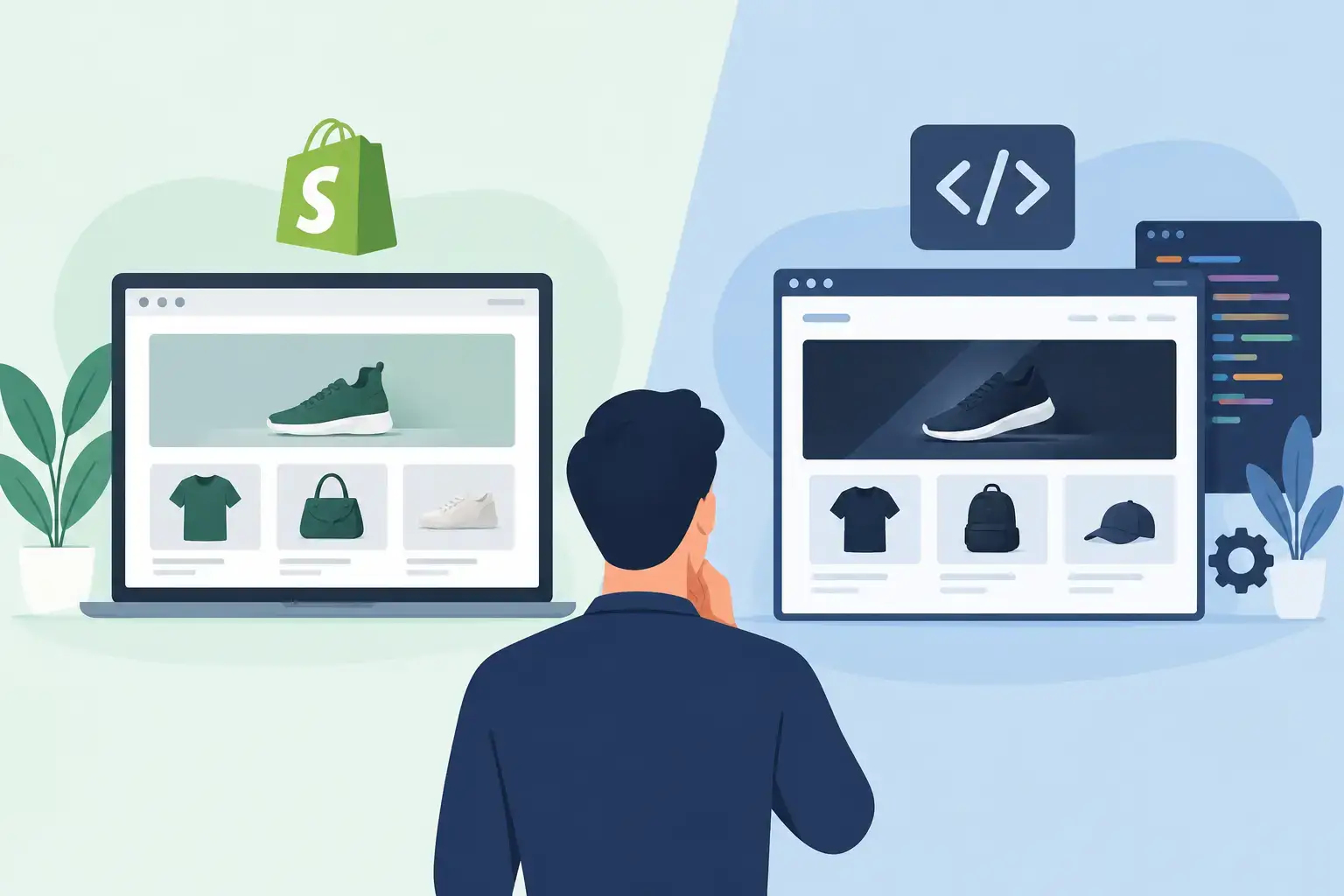
A retail business can launch a Shopify store in weeks. A custom storefront may take longer, but it can become a sales engine built around the way that business actually operates. That is the real decision behind Shopify versus custom storefronts: not which option sounds more advanced, but which one supports your next stage of growth without wasting budget, time, or opportunity.
For founders and business managers, the pressure is usually immediate. You need products online, payments working, mobile shoppers converting, inventory under control, and marketing campaigns sending visitors to pages that sell. The right platform helps you move faster. The wrong one creates workarounds, rising monthly costs, and a customer experience that feels like every competitor’s.


Shopify Versus Custom Storefronts: The Core Difference
Shopify is a hosted e-commerce platform. It gives businesses a ready-made foundation for product listings, shopping carts, payment processing, order management, security, and many day-to-day store functions. You select a theme, configure the store, add apps where needed, and launch without building every technical component from scratch.
A custom storefront is designed and developed specifically for your business. It may use a custom CMS, a headless commerce setup, or a tailored web application connected to payment gateways, inventory tools, CRM platforms, accounting software, or internal systems. Instead of adapting your business to a platform’s standard workflow, the platform is designed around your workflow.
Neither approach is automatically better. Shopify is often the smarter commercial decision for a new brand with a straightforward catalog. Custom development becomes more valuable when your sales model, operations, customer journey, or integrations are too specialized for an off-the-shelf setup.
When Shopify Is the Right Business Move
Shopify is built for speed. If you are launching a fashion label, beauty store, gift business, specialty food shop, or a focused retail catalog, it can get you selling quickly with far less technical complexity than a fully custom build.
The platform also gives non-technical teams a manageable back office. Staff can add products, process orders, update stock, create discount codes, and review sales without depending on a developer for every small change. This matters when a small team needs to stay focused on fulfillment, customer service, and marketing.
For businesses testing a product category or entering e-commerce for the first time, Shopify can reduce risk. You can validate demand before investing heavily in tailored software. Its app marketplace can also cover common needs such as email capture, reviews, loyalty programs, subscription products, abandoned-cart recovery, and social commerce.
However, apps are not a substitute for strategy. Every additional app can add a monthly fee, affect site speed, introduce compatibility issues, or make reporting harder to manage. A store that begins with a simple theme can become cluttered if features are added without a clear conversion plan.
Shopify works best when your operation fits a conventional e-commerce model: customers browse products, add them to a cart, pay online, and receive delivery or pickup. It is a strong choice when launch speed and predictable setup costs are more important than complete technical freedom.
Where Custom Storefronts Create More Value
Custom storefronts are for businesses that need more than a digital shelf. They are designed for companies that want their website to reflect a distinct sales process, customer journey, or operational model.
Consider a wholesaler that needs customer-specific pricing, approval-based orders, credit limits, and bulk quotation requests. Consider a travel business that needs custom package builders, availability logic, and lead routing to its sales team. Or consider a B2B supplier whose customers need to reorder thousands of SKUs from negotiated catalogs. These are situations where a standard store may require too many workarounds.
A custom storefront also gives you greater control over design and conversion paths. Your product pages, filters, checkout flow, account area, lead forms, and post-purchase experience can be planned around the actions that drive revenue. Instead of choosing from a fixed set of theme sections, you can build pages around your audience’s real questions and buying behavior.
Integration is another major advantage. A custom solution can connect directly to ERP software, inventory databases, CRM systems, POS tools, shipping providers, booking engines, or internal reporting dashboards. This reduces manual work and helps prevent the costly mistakes that occur when teams copy order data between systems.
The trade-off is clear: custom development requires more planning, a larger initial investment, and a trusted technical partner. It should not be chosen simply because custom sounds premium. It should be chosen because the business case is strong.
Cost Is More Than the Launch Price
Many businesses compare only the initial project quote. That approach can lead to expensive decisions.
Shopify usually has a lower upfront cost, especially when the store uses a proven theme and standard functionality. But the total cost can grow through monthly platform fees, premium apps, paid themes, transaction charges, custom app work, and ongoing support. A low-cost launch can become a high recurring expense if the store depends on multiple add-ons.
A custom storefront costs more at the start because design, development, testing, integrations, hosting, and quality control require specialized work. Yet it can provide better long-term value when it replaces repetitive manual processes, supports complex sales workflows, or improves conversion rates on high-value orders.
The right question is not, “Which option is cheaper?” Ask, “Which option will cost less to operate while helping us sell more?” A store that saves money on development but loses leads due to a poor buying experience is not truly affordable.
Performance, SEO, and Brand Control
Search visibility and site performance directly affect sales. Slow pages increase abandonment. Weak category structures make products harder to find. Generic content gives customers little reason to trust an unfamiliar brand.
Shopify offers a solid foundation for e-commerce SEO, including editable page titles, product descriptions, image alt text, collections, and basic technical controls. With the right setup, it can perform very well for many businesses. The limitation appears when a company needs highly specific URL structures, advanced content architecture, unusual filtering behavior, or complete control over how pages are generated and optimized.
Custom storefronts give greater freedom to build for speed, structured content, local search, multilingual audiences, and specialized landing pages. This is especially useful for brands running active SEO, paid advertising, email marketing, and social campaigns. When every campaign sends traffic to the same generic product template, conversion opportunities are lost. A tailored storefront can create focused experiences for different audiences, regions, or product lines.
Brand control matters too. A polished Shopify store can look excellent, but popular themes can make competitors feel visually similar. Custom design gives a business room to create a more memorable identity, from product discovery to checkout confirmation. For premium, hospitality, automotive, travel, and professional-service brands, that distinction can support trust before a sales conversation even begins.
How to Make the Decision
Choose Shopify when you need to launch quickly, sell a relatively standard range of products, manage the store with a small team, and keep initial investment controlled. It is a practical route for businesses that need to prove demand and begin generating online revenue without delay.
Choose a custom storefront when your business has complex pricing, specialized customer journeys, extensive integrations, unique product configuration, B2B requirements, or ambitious growth plans that standard templates cannot support. It is also a stronger choice when the website must function as a central business system rather than a standalone sales channel.
There is also a middle path. Some businesses start on Shopify with a carefully customized theme, conversion-focused product pages, and a clean app strategy. Others use Shopify as the commerce backend while creating a custom frontend experience. This can combine easier store management with a more distinctive customer-facing website.
Before choosing, map the full customer journey. Identify how customers discover products, what information they need before purchase, how pricing works, which systems your team uses, and where orders currently create delays. Those answers reveal whether you need a fast platform setup or a solution designed around your operation.
Your(1)Site helps businesses turn that decision into a working sales platform, combining e-commerce development, brand design, hosting, digital marketing, and technical support under one accountable team. The goal is not to sell the most complicated website. The goal is to build the storefront that helps your business attract qualified visitors, convert them with confidence, and keep growing after launch.
A good storefront should make buying easier for customers and running the business easier for your team. Start with the problems you need it to solve, then choose the technology that gives your business room to move.