


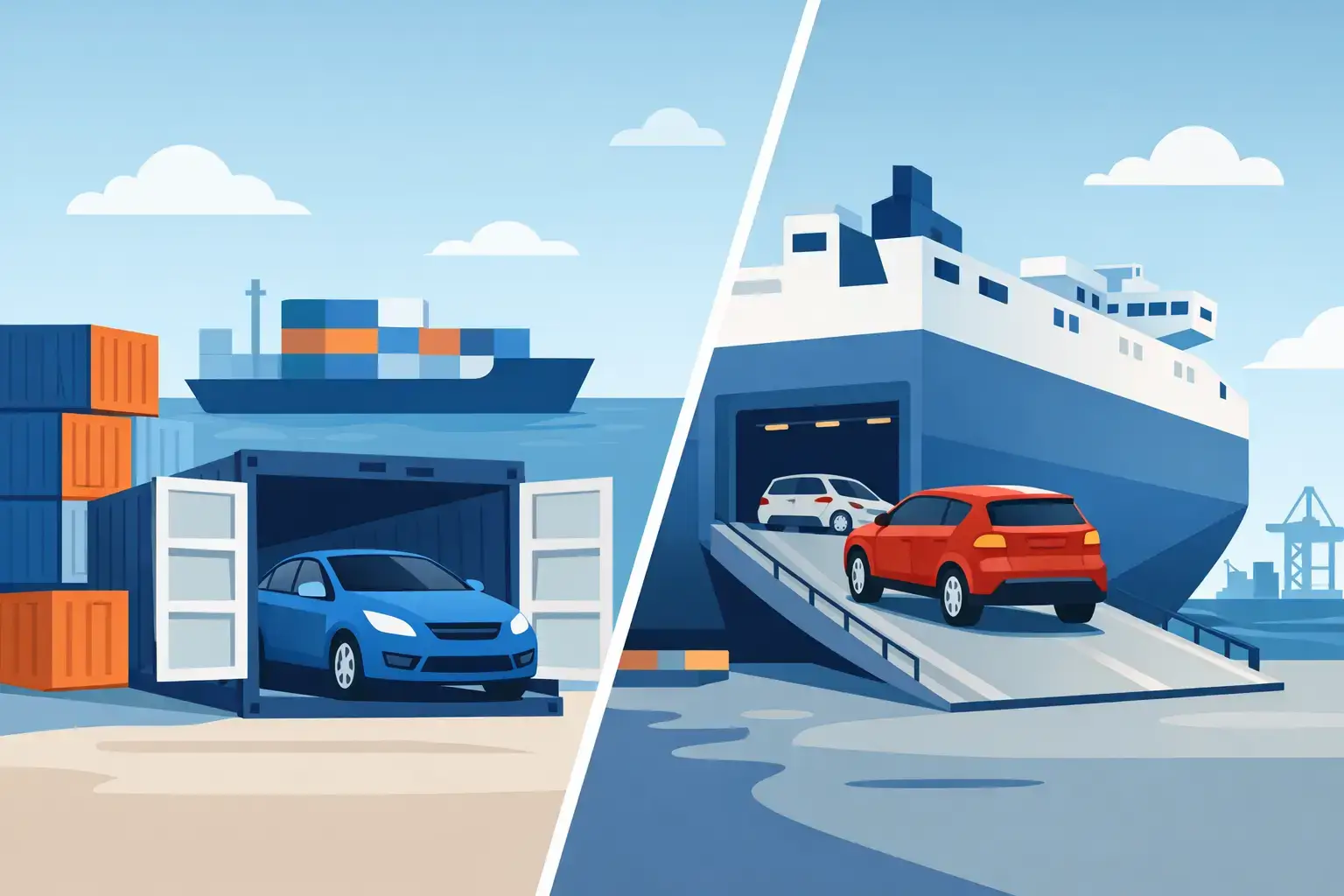
A vehicle can be ready for export, documents in order, pickup arranged – and still face the wrong shipping method. The container versus roro shipping decision affects more than the freight rate. It determines how your vehicle is handled, what can travel with it, which ports are available, and how well the shipment fits your schedule and risk requirements.
For a dealer moving regular volumes, a manufacturer shipping new units, or an individual exporting one family car, there is no universal winner. RoRo is often the most efficient answer for drivable vehicles on established trade lanes. Container shipping can provide more control, protection, and flexibility for high-value, non-running, or mixed cargo. The right choice starts with the vehicle, destination, and commercial priorities.


What Is RoRo Shipping?
RoRo means roll-on/roll-off. Vehicles are driven or towed onto a specialized vessel, secured on enclosed decks, and driven or towed off at the destination port. It is designed for cars, SUVs, vans, trucks, buses, and wheeled machinery that can be safely handled through the port and vessel ramps.
For standard, running vehicles, RoRo is usually the simpler operating model. There is no need to load the vehicle inside a container, strip it down at destination, or arrange container return. The carrier’s schedule, however, is tied to ports equipped for RoRo calls and to routes with sufficient vehicle volume.
RoRo vessels handle large numbers of units at once, which makes this method particularly practical for automotive manufacturers, dealers, fleet operators, and exporters moving multiple vehicles. A single private owner can also use RoRo when the destination is served and the vehicle meets the carrier’s acceptance conditions.
Where RoRo delivers value
The main advantage of RoRo is efficiency. On a suitable route, it can offer competitive pricing per vehicle and dependable sailing patterns. Port handling is purpose-built for rolling cargo, helping reduce the amount of packing and loading work required before departure.
RoRo also works well for oversized rolling equipment that cannot easily fit inside a standard container. Construction machinery, tractors, buses, trailers, and heavy vehicles may be better suited to a vessel deck than to a custom container-loading plan.
The trade-off is that the vehicle remains accessible within the vessel environment. It is secured professionally, but it is not enclosed in a private steel box. Most RoRo carriers also restrict personal effects, loose spare parts, and commercial goods inside the vehicle. Those restrictions are important for safety, customs compliance, and cargo liability.
What Is Container Shipping?
Container shipping places the vehicle inside a sealed shipping container, typically a 20-foot or 40-foot unit. Depending on dimensions, a 40-foot container may hold two standard vehicles, and specialized loading plans can accommodate multiple units where size, weight, and destination rules allow. Each vehicle is blocked, braced, lashed, and protected to prevent movement during ocean transit.
A container can travel on services serving a far broader network of ports than RoRo. That matters when the destination is inland, the nearest RoRo terminal is not practical, or the route requires transshipment through a major container hub.
Containerization is also useful when a shipment includes approved accessories, spare parts, or other cargo that needs to move with the vehicle. Requirements vary by country, carrier, and commodity, so these items must be declared correctly and packed safely. A container is not permission to load household goods or undeclared cargo around a car.
Where containers deliver value
The biggest benefit is physical separation. A sealed container provides additional protection from external exposure and limits access during transport. This is often preferred for classic cars, luxury vehicles, prototype units, collector vehicles, motorcycles, and vehicles moving with compliant parts or equipment.
Containers can also make economic sense when two or more vehicles can share a unit. The cost is then allocated across the shipment rather than charged vehicle by vehicle. For a dealer or exporter consolidating compatible vehicles, this can be a useful option, especially on lanes where container freight is readily available.
However, container shipping requires skilled loading, correct lashing materials, careful measurement, and more terminal coordination. A vehicle that appears to fit on paper may need a different loading configuration because of ground clearance, wheelbase, height, weight distribution, or door access. Professional planning is essential, particularly for high-value vehicles and multi-vehicle loads.
Container Versus RoRo Shipping: The Key Differences
Cost is often the first question, but it should not be the only one. RoRo commonly has a lower base cost for one standard, operable vehicle on a direct route. Container freight can be higher for one car because the shipper pays for the equipment and loading process, yet it may become competitive when the container is shared or when the destination requires a container service.
Protection is the next major distinction. RoRo vehicles are secured inside a purpose-built ship, but they are not individually enclosed. A container adds a closed, sealed transport environment and allows the vehicle to be professionally braced in place. That added control can justify the cost for a collector vehicle, a sensitive shipment, or a car moving with eligible cargo.
Route availability can reverse the decision entirely. A direct RoRo sailing may be faster and less expensive than container shipping through multiple hubs. In another market, container services may sail more frequently, reach a closer port, and connect more easily to inland trucking or rail. The best mode is the one that works across the complete route, not just the ocean leg.
Vehicle condition matters too. RoRo carriers generally require vehicles to be safely driven or towed, with working brakes, steering, and rolling wheels. Non-running cars, accident-damaged units, project vehicles, or vehicles with special handling requirements may be accepted only under specific conditions or may be better shipped in containers. Dangerous-goods rules also apply to electric, hybrid, damaged, and modified vehicles, so early disclosure is necessary.
Choosing the Right Method for Different Shipments
For one standard, running car moving between major vehicle ports, RoRo is often the straightforward choice. It is designed for precisely that shipment profile and avoids the additional work of container loading and unloading.
For a luxury, classic, or collector vehicle, container shipping is often worth serious consideration. The decision is not based on value alone. It also depends on the vehicle’s condition, destination handling, transit route, insurance requirements, and whether the owner needs to ship approved parts alongside it.
For dealers and exporters moving volume, the answer may be a combination of both methods. RoRo can handle regular production vehicles efficiently, while containers can serve secondary destinations, special models, mixed loads, and shipments requiring more controlled handling. A flexible logistics plan should not force every vehicle into the same transport mode.
For machinery and oversized equipment, dimensions and operability drive the decision. Wheeled equipment may travel by RoRo, while static, crated, dismantled, or unusually shaped cargo may require a container, flat rack, or another specialized solution. Freight should be measured and assessed before booking, not after it reaches the port.
Questions to Settle Before You Book
Before selecting a service, confirm the vehicle’s exact dimensions, running condition, declared value, destination port, and final delivery location. Ask whether the route is direct or requires transshipment, what port handling charges apply, and whether the quoted rate includes origin and destination services.
You should also clarify documentation requirements early. Title or ownership documents, export certificates, commercial invoices, packing details, inspection paperwork, and destination import approvals can all affect release. The rules differ by country and by whether the shipment is a private export, commercial sale, temporary import, or relocation.
Do not compare quotes only by the ocean freight figure. A lower freight rate can become more expensive if it excludes loading, terminal handling, storage, customs support, delivery, or special equipment. A clear shipment plan identifies each charge and each handoff before the vehicle enters the yard.
Euro Star Shipping Services coordinates both standard and exceptional vehicle movements through Dubai, with the facilities and specialist handling needed for single cars, multi-vehicle container loads, heavy equipment, and more demanding cargo. The practical aim is simple: match the shipment to the mode that protects the cargo, controls cost, and gets it to the correct destination without avoidable delays.
The best shipping decision is made before the vehicle reaches the port. Share the vehicle details, destination, timing, and any special requirements with a shipping specialist early, and the right path usually becomes clear.