


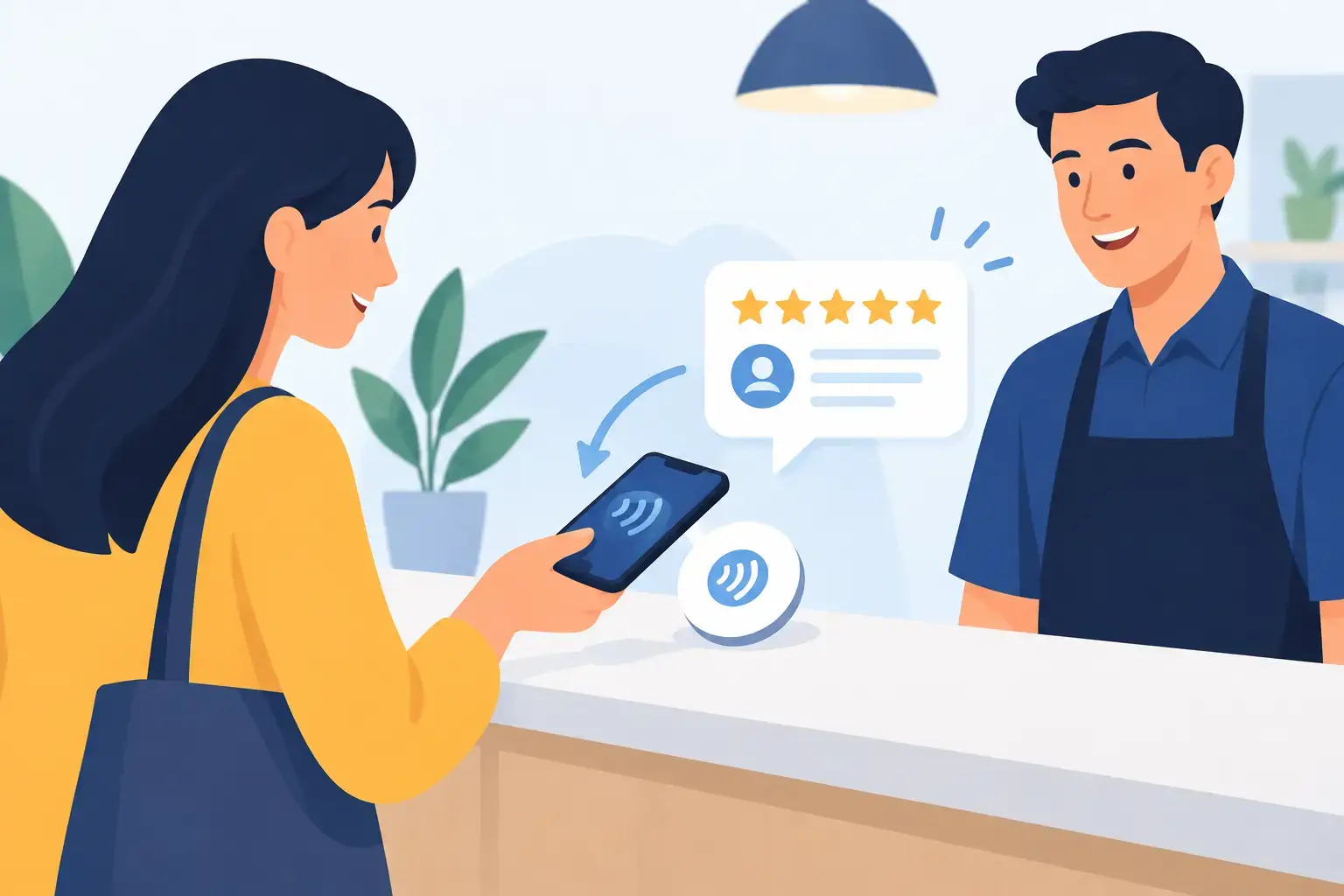
A guest compliments the meal. A patient thanks the front desk. A client leaves the salon looking and feeling great. Those are high-trust moments, but they pass quickly. NFC stickers give customers a direct path to leave a review, follow your business, or visit a chosen page with one phone tap – while the experience is still fresh.
For customer-facing businesses, the value is not in the technology alone. It is in removing the awkward pause between a positive interaction and online action. Instead of asking a customer to search for your business later, staff can point to a polished sticker, sign, or display and say, “A quick tap helps us a lot.”


What NFC Stickers Do at the Point of Service
An NFC sticker contains a small chip that communicates with an NFC-enabled smartphone at close range. When a customer taps their phone to the sticker, the phone opens the destination you selected. That could be your Google review page, TripAdvisor profile, Booking.com listing, Trustpilot page, Facebook page, Instagram profile, WhatsApp chat, menu, booking page, or a custom URL.
Most modern smartphones support NFC. On many devices, the customer simply holds the phone near the sticker and taps the notification that appears. There is no app to download, no account to create, and no need for staff to explain a complicated process.
The strongest NFC products also include a visible QR code. That matters because customer behavior varies. Some people naturally tap; others are used to scanning. Giving both options on the same elegant piece means more customers can act in the way that feels familiar to them.
For a restaurant, the best destination may be Google Reviews. For a hotel, it may be TripAdvisor or Booking.com. A clinic may direct patients to Google after a successful appointment, while a retailer may use the same technology to grow Instagram followers or start a WhatsApp conversation. The physical item stays in place; the digital destination does the work.
Why a Tap Can Produce More Reviews
The biggest obstacle to collecting reviews is rarely customer satisfaction. It is friction. A customer may genuinely want to support your business, then get distracted by a call, a commute, or the next task on their list. By the time they remember, the moment has gone.
NFC reduces the number of steps between intent and action. Customers do not need to open a browser, search a business name, find the correct profile, and locate the review button. They tap or scan, land where they need to be, and can respond immediately.
That speed also helps your team. Staff should not need to memorize a long URL or walk customers through a phone screen. A discreet prompt at checkout, on a table, or near reception makes the request consistent without turning every interaction into a sales script.
The commercial effect can be meaningful. More recent, authentic reviews strengthen social proof for prospective customers comparing local options. Better review volume and ratings can support local visibility, build confidence before a booking or visit, and give owners a clearer picture of what customers value. The goal is not to pressure every customer. It is to make feedback easy for people who are already willing to give it.
Where NFC Stickers Work Best
Placement determines whether a sticker becomes a useful customer-engagement tool or an overlooked detail. Put it where customers have a natural pause, a positive impression, and a phone in hand.
At a café or restaurant, that may be on the bill presenter, counter, table tent, takeaway bag, or exit door. A hotel can place a tap point at reception, in guest welcome materials, near checkout, or on a branded keyring. Dental practices, clinics, and salons often get strong engagement at the front desk immediately after payment or rebooking.
Gyms can add NFC tags near the welcome desk or retail counter. Retailers can use them on checkout displays, packaging inserts, and service counters. Home-service businesses can place a weather-resistant tag on an invoice folder, vehicle display, or leave-behind card once a job is complete.
The setting should match the product. A small NFC sticker is ideal for a counter, mirror, menu holder, or product package. A premium stand can make more sense at a hotel desk, medical reception, or upscale salon where presentation is part of the brand experience. Table tents, coasters, plaques, and custom displays give businesses more room for a clear call to action and branded color treatment.
Choosing NFC Stickers for Your Business
A basic sticker can direct customers to one destination, but the best choice depends on how you operate, where it will be used, and how polished you need it to look.
Start with the action you want. If your priority is review growth, direct customers to the specific review platform that drives discovery in your industry. If you need more bookings, menu views, social followers, or direct messages, choose that destination instead. One clear action usually performs better than a crowded message asking customers to do everything at once.
Next, consider durability and visibility. A sticker at a busy counter needs to withstand regular handling and cleaning. A tag used outdoors or on equipment needs a suitable finish. In premium environments, a branded stand or plaque may create a stronger impression than a plain label. The tap point should look intentional, not like an afterthought.
Finally, choose flexibility when your needs may change. Some NFC and QR solutions allow you to assign or update the destination after purchase. That is useful when you are opening a new location, changing platforms, running a campaign, or moving from a general social profile to a direct review link. It keeps a well-designed physical asset useful rather than disposable.
ReviewsLink offers NFC and QR products across stickers, cards, tags, coasters, table tents, stands, and custom branded displays, so businesses can match the format to the customer moment rather than forcing one product into every setting.
Set Up the Experience Before You Put It on Display
A tap point should be ready before it reaches the counter. First, select the exact destination and test it on both iPhone and Android devices. Confirm that it opens the correct business profile, not a duplicate listing, outdated location, or generic homepage.
Then write a short, natural prompt. “Tap to leave us a Google review” is clearer than a vague message about sharing feedback. If a QR code is present, mention both actions: “Tap or scan to share your experience.” Customers should understand what will happen before they use their phone.
Train staff to mention the request at the right time. The ideal moment follows a compliment, a resolved issue, a successful treatment, a completed purchase, or a positive checkout conversation. A simple invitation is enough. Avoid asking while a customer is frustrated, rushing, or still waiting for service.
Keep review collection ethical. Do not offer discounts, gifts, or entries in exchange for positive reviews. Do not direct only happy customers to public review sites while routing dissatisfied customers elsewhere. Ask for honest feedback, respond professionally when concerns arise, and follow each platform’s policies. Credibility is far more valuable than a short-lived spike in ratings.
Make the Display Easy to Notice, Not Easy to Ignore
A sticker can be small, but it should not be invisible. Use a clean contrast between the call to action and the background. Place it at eye level or hand level, not behind a register screen, beneath clutter, or in a spot where customers must lean over staff to see it.
For high-volume locations, use more than one touchpoint. A restaurant may have a table tent plus a checkout display. A clinic may use a reception plaque and a small card at checkout. The goal is not repetition for its own sake. It is giving customers a second chance if the first moment was too busy.
Review performance is also a useful signal. If one location or placement creates more engagement, study what is different. Is the request made at a better moment? Is the display more visible? Is the call to action clearer? Small adjustments to timing and placement can outperform a complete redesign.
Common Questions About NFC Stickers
Do customers need a special app?
No. NFC-enabled phones can read a properly programmed NFC sticker without a special app. A QR code provides an easy alternative for customers who prefer to scan or have NFC turned off.
Can one sticker be used for different platforms?
It depends on the setup. A sticker can send customers to one chosen link, while a flexible management system may let you change that link later. You can also create a landing page that presents multiple choices, though a direct link is usually better when review generation is the priority.
Are NFC stickers only for reviews?
No. They can support reviews, social follows, online ordering, bookings, menus, promotions, contact details, loyalty programs, and customer support. The most effective use is the one that matches the immediate customer moment.
A well-placed NFC sticker does not replace great service. It gives great service a practical way to travel beyond your front door, onto the platforms where future customers decide whom to trust.