


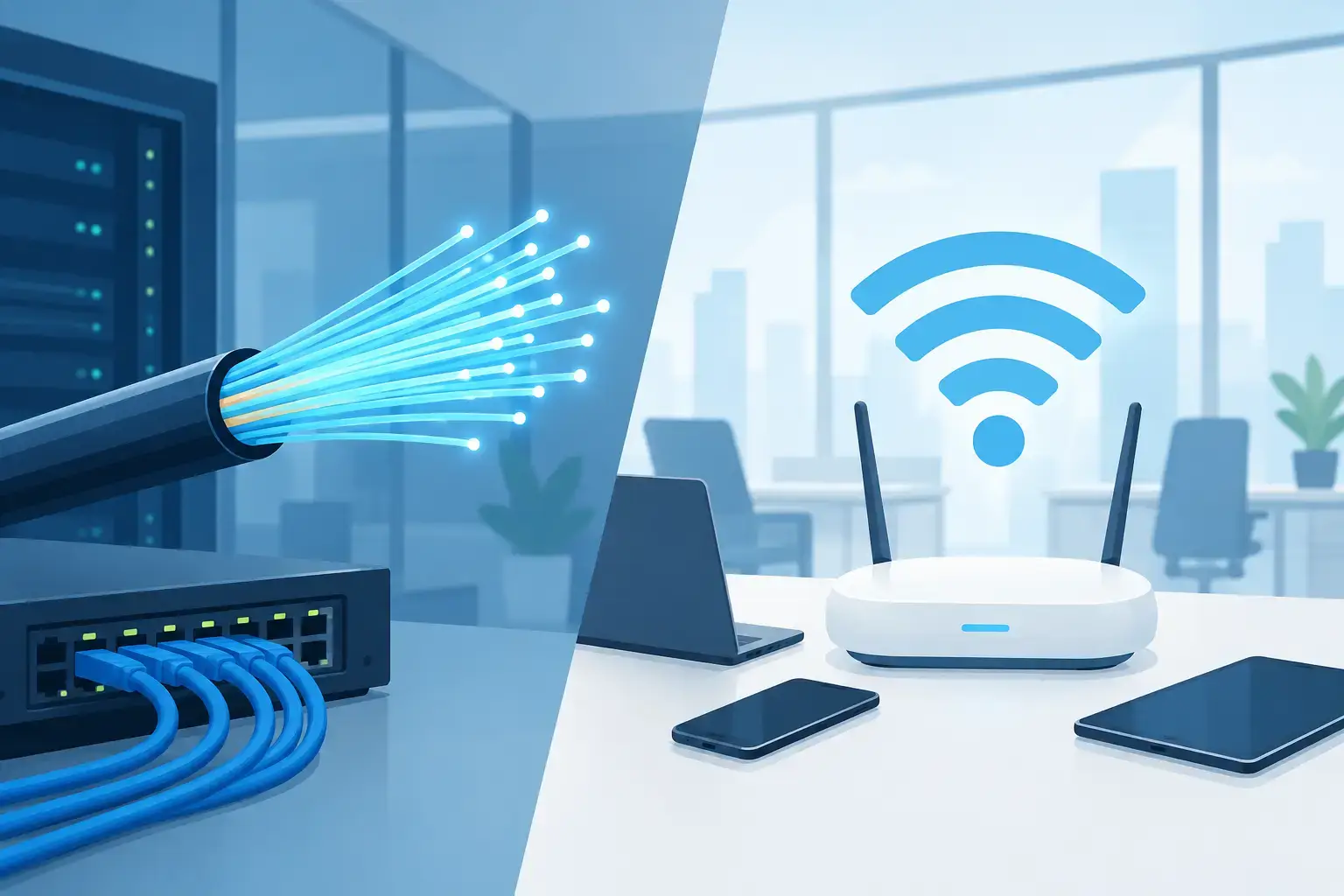
A slow connection is not just an IT annoyance. It can delay customer payments, interrupt cloud software, freeze video meetings, weaken CCTV coverage, and leave staff waiting when they should be serving customers. The choice between fiber versus wireless networking affects how confidently a business can grow, especially when every sale, system, and customer interaction depends on staying connected.
For many businesses, this is not a choice between one technology and the other. Fiber and wireless solve different problems. The strongest network designs use each where it delivers the best business result: fiber for high-capacity, fixed connections and wireless for flexible access across people, devices, and locations.


Fiber Versus Wireless Networking: The Core Difference
Fiber networking sends data through strands of glass using light. It is a physical wired connection, usually installed between buildings, floors, communications rooms, switches, servers, or key equipment. Because it supports very high bandwidth over long distances, fiber is often the foundation of a serious business network.
Wireless networking sends data through radio signals, most commonly through Wi-Fi access points. It gives laptops, phones, tablets, scanners, smart TVs, point-of-sale devices, and visitors the freedom to connect without a cable at every desk or device.
That difference matters. Fiber creates a highly stable pathway for data. Wireless creates mobility and convenience. A hotel needs guests to move freely with their devices. A warehouse may need handheld scanners across a large floor. A financial office may need uninterrupted wired connectivity for workstations, servers, and secure records. The right answer depends on what is happening in the space, not on which option sounds more modern.
Why Fiber Is the Backbone for High-Performance Operations
Fiber is built for businesses that need capacity, consistency, and room to expand. It can carry large volumes of data with low latency, meaning less delay between a request and a response. That becomes valuable when teams rely on cloud platforms, large file transfers, centralized storage, IP phones, high-resolution surveillance, backups, and video conferencing at the same time.
A wired fiber connection is also less affected by physical obstructions and radio interference than Wi-Fi. Thick walls, concrete structures, metal shelving, neighboring wireless networks, and busy public spaces can all reduce wireless performance. Fiber does not face those same signal challenges once it is correctly installed and protected.
For a multi-floor office, retail chain, school, clinic, or commercial building, fiber is often the best way to connect network cabinets and distribute reliable bandwidth throughout the property. It can also support long cable runs where standard copper cabling becomes less practical.
Security is another advantage. Accessing data on a physical fiber connection generally requires physical access to the network infrastructure, while wireless signals travel through the air and need careful encryption, authentication, and monitoring. Wi-Fi can absolutely be secured professionally, but it requires active management rather than assumptions.
Fiber does have trade-offs. Installation can require planning, cabling routes, equipment cabinets, civil work, and a higher upfront investment. A business moving offices soon or operating from a temporary site may not want to make that commitment. The installation must also be designed properly from the beginning, because poor labeling, weak termination, or no allowance for expansion can turn a good investment into an expensive headache.
Where Wireless Networking Wins
Wireless is the practical choice when people and devices need to move. Employees expect to work from meeting rooms, reception areas, shared desks, and outdoor spaces. Customers expect Wi-Fi in cafés, hotels, clinics, showrooms, and waiting areas. Wireless networks make these experiences possible without filling every room with cables.
For small offices, a well-designed Wi-Fi network may be all that is needed for daily operations, provided the internet connection, access points, and security settings are appropriate for the number of users. It is also faster to deploy than extensive fiber infrastructure and easier to adapt when desks, departments, or equipment locations change.
Wireless is particularly useful for businesses with mobile operations. Retail staff using tablets, restaurant teams using handheld ordering systems, warehouse personnel using scanners, and field teams accessing cloud applications all benefit from reliable coverage rather than a fixed cable connection.
But Wi-Fi performance is never only about the internet plan. A fast internet connection cannot overcome poorly placed access points, congested radio channels, outdated equipment, or too many devices sharing limited capacity. One low-cost router placed at reception is rarely enough for a growing business with multiple rooms, walls, floors, and users.
A professional wireless design considers coverage, user density, device types, building materials, guest access, and application needs. A video call, cloud backup, security camera, and casual web browsing do not place the same demands on a network. Treating every device the same is how businesses end up with complaints, dropped connections, and staff workarounds.
Speed Is Not the Only Decision Factor
It is easy to compare fiber and wireless by advertised speed alone. That can be misleading. A network must be judged by the experience it gives users during real business activity.
Fiber usually offers more predictable performance, especially when many users are active at once. It is ideal for fixed systems that cannot afford interruptions, including servers, network switches, CCTV recorders, VoIP systems, and desktop workstations handling heavy data. It also creates a strong internal backbone even if the external internet service is delivered by another provider.
Wireless can provide excellent speeds with modern equipment, but performance varies based on distance, walls, interference, and the number of connected devices. A wireless connection that works perfectly in a quiet office may struggle during an event, a busy restaurant service, or peak hotel occupancy.
The key question is not, “Which technology is faster?” Ask instead, “Which systems need guaranteed performance, and which users need mobility?” That question leads to better spending decisions.
The Best Choice Is Often a Hybrid Network
Most growing organizations should not think in terms of fiber or wireless. They should build a hybrid network.
In this model, fiber or structured cabling connects the internet gateway, firewall, switches, server room, CCTV recording equipment, and access points. Wi-Fi then delivers connectivity to mobile users and devices across the premises. The wireless network is only as dependable as the wired infrastructure supporting it.
This approach gives a business the best of both options: high-capacity, stable core connectivity and flexible access where teams and customers need it. It also makes future expansion easier. New access points, cameras, workstations, and departments can be added without rebuilding the entire network.
A retail business, for example, may use wired connections for point-of-sale terminals, cameras, and back-office systems while offering separate Wi-Fi for employees and guests. A medical clinic may use fiber between floors, secure wired links for sensitive systems, and controlled wireless access for staff tablets. A warehouse may use wired backbone connections to strategically positioned access points, ensuring scanners stay connected across operational areas.
Plan for Security, Growth, and Support
Whether you choose fiber, wireless, or both, network design should include more than cables and access points. Businesses need separate access for employees, guests, smart devices, and critical systems. A guest Wi-Fi network should not share unrestricted access with accounting records, CCTV equipment, or internal servers.
Network equipment also needs protection through firewalls, strong passwords, software updates, access controls, and monitoring. Power planning matters too. A UPS can keep essential networking equipment running during short outages and prevent sudden shutdowns from disrupting operations or damaging hardware.
Growth should be part of the initial plan. A network that meets the needs of ten employees may fail quickly when the business reaches thirty, adds cloud applications, installs more cameras, or opens another floor. Installing extra cabling capacity and selecting scalable equipment is usually more cost-effective than repeatedly replacing a network after it becomes a bottleneck.
Your(1)Site helps businesses plan and deploy networking infrastructure that supports daily operations and future growth, from structured cabling and fiber connections to secure Wi-Fi, CCTV, power solutions, and ongoing technical support.
Make the Network Serve the Business
Fiber is the stronger choice for stable, high-capacity connections between fixed systems and across larger spaces. Wireless is the smarter choice for mobility, convenience, and customer access. Neither is automatically better in every situation.
Start with the way your team works, the applications you depend on, the layout of your premises, and the cost of downtime. A network designed around those realities will do more than deliver internet access – it will give your people the speed and confidence to keep business moving.