


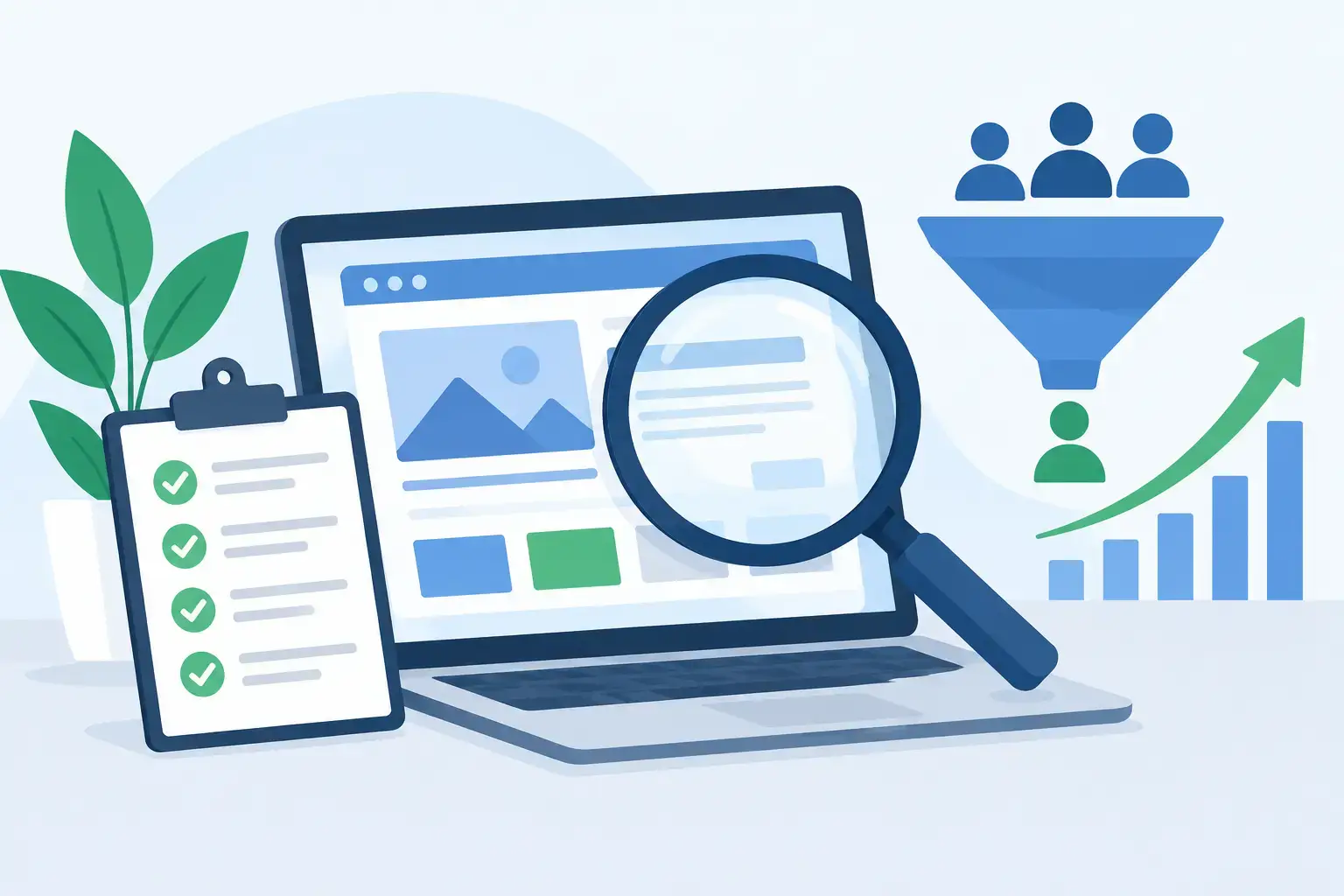
A website can look professional and still lose business every day. A slow mobile page, an unclear service message, a broken contact form, or weak search visibility can quietly send ready-to-buy visitors to a competitor. A business website audit review brings those hidden problems into focus and turns them into a practical plan for more traffic, stronger leads, and higher sales.
For business owners, this is not about collecting a long list of technical issues that nobody acts on. It is about answering direct commercial questions: Can customers find us? Do they understand what we offer? Can they trust us? Can they contact or buy from us without friction? And what should we fix first to see a meaningful result?


What a Business Website Audit Review Should Deliver
A useful audit connects every finding to a business outcome. If a page takes too long to load, the cost is not only a lower performance score. It is a visitor who leaves before seeing your offer. If your services are not organized around the words customers use in search, the cost is missed opportunities from people already looking for a solution.
The best review gives you a clear view of where your website is working, where it is holding back growth, and which improvements deserve immediate investment. It should separate urgent issues from nice-to-have enhancements. This matters for small and mid-sized businesses that need progress without wasting time or budget.
A strong audit usually examines six connected areas: technical health, mobile performance, search visibility, user experience, conversion paths, and measurement. These areas overlap. Better page speed can support search rankings and keep visitors engaged. Clearer page messaging can improve both paid advertising performance and lead conversion.
Start With the Customer Journey, Not the Homepage
Many business owners judge a website by its homepage alone. Customers do not always arrive there. They may land directly on a service page after a Google search, an online store category from an ad, or a blog article shared on social media.
Your audit should trace the real journey from first visit to inquiry, call, booking, or checkout. A travel agency may need visitors to request a package quote. A clinic may need appointment calls. A retailer may need a fast and trustworthy checkout. A B2B company may need qualified prospects to submit a project brief.
Look at each key landing page and ask whether it answers four questions quickly: what do you offer, who is it for, why should customers choose you, and what should they do next? If the answer requires several paragraphs of reading, the page is probably doing too much work before earning attention.
Make the Next Step Obvious
A website should never leave a potential customer wondering how to move forward. Calls to action such as “Request a Quote,” “Book a Consultation,” “Call Now,” or “Shop the Collection” need to match the visitor’s intent.
For higher-value services, asking for a phone number, company name, budget, project details, and several other fields on the first contact form may create unnecessary friction. For a simple quote request, a shorter form often produces more leads. The trade-off is lead quality, so the right approach depends on your sales process. An audit can identify where your form is too demanding or too vague.
Review Mobile Speed and Technical Reliability
For many businesses, mobile visitors represent the largest share of website traffic. A site that works perfectly on an office desktop but feels slow or difficult on a smartphone has a real sales problem.
Check how quickly important pages load on mobile data, not only on a fast office connection. Large images, unoptimized video, excessive scripts, and poor hosting can all add delay. Each extra second can weaken visitor confidence, especially when a customer is trying to compare providers, call a business, or make a purchase quickly.
Technical reliability also includes broken pages, missing images, faulty forms, redirect errors, expired security certificates, and outdated software. These may seem like back-office details, but customers notice the result. A warning message, a nonworking payment page, or an email form that never sends can damage trust immediately.
Security and backups belong in the review as well. Businesses collecting customer details, handling transactions, or running custom systems need a clear process for updates, monitoring, backup recovery, and access control. The cheapest hosting option is rarely affordable if downtime costs you leads, sales, or reputation.
Examine Search Visibility With Commercial Intent
Search engine optimization is not just about ranking for broad industry terms. A restaurant wants local diners. A law firm wants people seeking a specific legal service. An e-commerce brand needs shoppers who are ready to compare and buy.
During a business website audit review, assess whether each major service or product has a dedicated, well-structured page. A single page listing every service may be easy to publish, but it is often weak for both customers and search engines. Specific pages give you room to explain the offer, show relevant proof, address common questions, and provide a focused call to action.
Page titles, descriptions, headings, image text, internal navigation, and written content should all support a clear topic. Avoid stuffing keywords into every sentence. Instead, write the way a helpful sales professional would explain the service to a serious prospect.
Local businesses should also review whether their location, service area, phone number, business details, and map information are consistent. This is especially important for companies serving more than one city or country. Accuracy helps customers contact the right team and supports stronger local visibility.
Check Whether Your Content Builds Trust
Visitors often decide whether to contact a business before they compare every technical detail. They look for signals that the company is real, experienced, responsive, and able to deliver.
An audit should review your service descriptions, portfolio examples, testimonials, team information, project process, and company credentials. Generic claims such as “best quality” and “excellent service” rarely persuade on their own. Specific proof is stronger: the type of projects you handle, the industries you understand, the results you pursue, and the support customers can expect after launch.
This does not mean every page needs to be long. It means every page needs a job. A service page should explain the offer and produce inquiries. A portfolio page should prove capability. An article should attract relevant search traffic and demonstrate expertise. A contact page should remove hesitation and make contact easy.
Measure What Happens After the Click
Without accurate tracking, a business may spend money on SEO, paid ads, social media, or email campaigns without knowing which activity produces results. Website traffic alone is not enough. Ten thousand visitors who never call, submit a form, or buy are less valuable than one hundred visitors with strong purchase intent.
Your audit should confirm that meaningful actions are measured. Depending on the business, that may include form submissions, phone-clicks, WhatsApp inquiries, appointment bookings, downloads, purchases, add-to-cart actions, or quote requests. It should also identify the source of those actions, so marketing decisions are based on performance rather than guesswork.
For example, a campaign may generate plenty of visits but few qualified leads because it sends people to a general homepage. Directing those visitors to a focused service landing page with a clear offer can change the outcome. Analytics makes that improvement visible.
Turn Findings Into a Growth Plan
The final stage is where many audits fail. A 40-page report is not useful if it leaves you unsure what to do next. Your priorities should be organized by impact, effort, and urgency.
Fix issues that prevent leads or sales first, such as broken forms, checkout errors, severe mobile speed problems, security warnings, or pages that are not being indexed. Next, improve high-value service and product pages that already receive traffic but fail to convert. Then build longer-term growth through content, SEO improvements, campaign landing pages, and ongoing technical maintenance.
Some businesses can apply quick fixes internally. Others need a team that can manage design, development, hosting, search optimization, paid campaigns, and business technology in one coordinated process. That is where an end-to-end partner such as Your(1)Site can reduce delays and keep every improvement connected to the same business goal.
Your website should not be an online brochure that sits quietly after launch. Treat it as a working sales asset: test it, measure it, improve it, and give every visitor a clear reason to become your next customer.